Comfortable Can Be Scary…
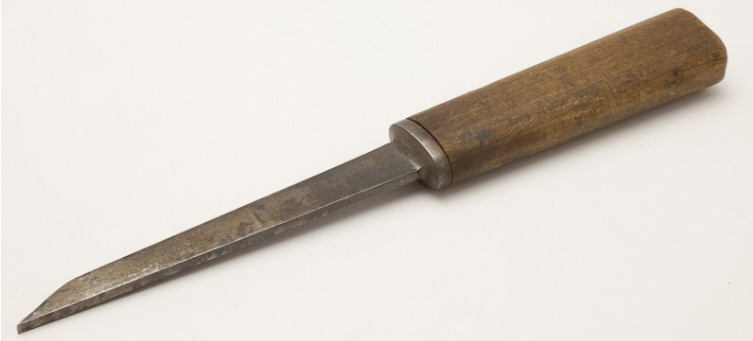
Stock Photo (er... something I snagged from the web)
E-mail Trail from earlier this week between me and my favourite tool pusher dealer…
Me: Patrick, do you still have that 1/8″ mortising chisel? If so, I’d like to buy it.
Patrick: The 1/8″ chisel sold. I may have another, but I have to unload my van to see what remains of the mortice chisel carnage. I’ll be back with you once I do that…
*Two days later*
Patrick: Ethan, I found another 1/8″ mortice chisel. It’s a Howarth, a very fine make, one of Sheffield’s best, it needs a clean and will do so well. Original handle, length, blah, blah, blah…
Ethan: Is it a pig sticker style or round handled? If pig sticker, then I’ll take it.
Ethan: Just did a quick Google search for Howarth mortice chisels and they all appear to be pig stickers. I’ll take it.
Patrick: I’ll have it in today’s mail, shipping is the usual postage on the box, blah blah blah… ;^)
In retrospect, the comfort level and ease of that transaction scares me (as it probably should). Really? I just bought a mortice chisel with a description that included, “blah, blah, blah”?
Don’t get me wrong – I’m not regretful of the purchase. I require an 1/8″ mortice chisel and Patrick has always, always, always done me right. And if it isn’t right, he’ll make it so.
But it still scares me…
Book Review: Decorative Wood Inlay

Decorative Wood Inlay by Zachary Taylor
At some point in their woodworking endeavors, most people will find themselves doing inlay of some sort. It might be intentional, such as the addition of stringing to table legs or banding to the lid of a box, or it might be to cover up a mistake, like when I had to inlay an escutcheon into the front of a box to cover up an error I made cutting the key hole. Whatever the reason, it never hurts to have a book handy to get you through these times. Decorative Wood Inlay is the first book I reach for when I want a refresher to get me prepared for my next inlay venture.
Zachary Taylor is a woodworker from England who comes complete with the dry, wry humor we tend to associate with our brethren from across the pond. His writing style is clear and concise and easy to follow, but also very “British”. While wordsmiths will find joy in such sentences as, “The stroke is completed with the same attitude of the blade to the hone,” others might have trouble digesting the English nuance. In this case, he means the blade should be in the same position on the sharpening stone when it ends as when it began.
The book is organized in an easy-to-follow format, beginning with a brief history of inlay and ending with, as he so aptly puts it, “the finish”. Some of the chapters are a bit sparse, like the history (well… he does call it “brief”) and the last two chapters on adhesives and finishes. In his defense, however, I would point out that a book written on inlaying wood in a decorative manner should mostly cover the process of inlaying wood and not focus on the most basic mechanics of woodworking.
The first few chapters are useful to the beginning woodworker who already knows they want to incorporate inlay of some sort in many of their pieces. Chapter 2 covers the tools and equipment one might find useful while Chapter 3 discusses what Mr. Taylor deems to be important features for a shop setup. It is important to keep in mind that his ideal workshop is created with his kind of work in mind, so it certainly wouldn’t work for someone who builds kitchen cabinets for a living.
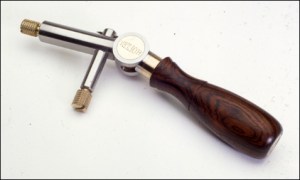
Purfling Cutter by Karl Holtey
The bulk of the book, of course, is spent discussing various types of inlay, covering several techniques for each type. Mr. Taylor starts with one of the simplest types, corner banding. His first method uses a custom purfling tool made for him by Karl Holtey, one of Britain’s master plane makers (drool). The second and third methods involve multi-tools (e.g. Dremel) and hand-made scratch-stocks.
He follows this process for each technique he discusses – how to perform the function with a variety of tools, going into enough detail with each method that they all seem comfortable and do-able. Throughout the next chapters, he outlines inlaying stringing, inlaying curved stringing, inlaying panels and motifs, and inlaying irregular shapes. Each technique he discusses builds upon the previous, finally ending with the high-end techniques of inlaying guitar rosettes and purfling.
Over the past seven years, I’ve amassed a nice little collection of woodworking books. Many of them are quite enjoyable and do get read from time to time. But this book gets pulled down from the shelf for reference and for reading pleasure more than almost any other. I think it would be a fine and inexpensive addition to any woodworker’s library.
She has us pegged!

The Anarchist's Tool Chest
The other day I was down in the lunch room, getting ready to dive into another thorough reading of The Anarchist’s Tool Chest by Chris Schwarz, trying to avoid the trials and tribulations of work for 45 minutes.
(I think I’m on the 5th or 6th time now, and with each reading I find something new!)
When I opened the book, a slip of paper fell out. I glanced at it and immediately noted the handwriting was definitely not mine. For starters, it was written in blue ink using a ballpoint pen and I only use black EnerGel pens by Pentel.
(What? I’m a writer! These things matter.)
My interest was peaked. I spread the note out on the table and read:
A perfect book: by the OCD,
for the OCD.
To wit: p.427 says it better than I could.
Well… I certainly didn’t write THAT! It wasn’t Dana’s handwriting, and Finley doesn’t know cursive (… ok, he can’t print, either; but he does have a vocabulary of 30+ words – not too bad for a 14-month-old), so who could it have been?
Ahhh… there is only one other option: Dana’s mother-in-law.
She occasionally helps us by watching Finley in our home when either he or the sitter (or one of her kids) is sick. And she likes to snoop about, seeking tasty snacks or interesting tidbits to occupy her time when he is napping. I suspect she thumbed through my book on one of those most recent occasions and thought she would leave a funny note for her mildly-OCD son.
She also seems to be obsessed with the fact that her mildly-OCD son is becoming more and more like her majorly-OCD husband. What she should be worried about is that her daughter-in-law is becoming more and more like her!
(Or maybe I’m the one who should be worried…)
Out of curiosity, I flipped to page 427 to see what it said. Ha! It’s the section on timing your screws. Damn! We’ve been called out, Chris! And I’m afraid we have no defense!
(A call to my mom earlier today confirmed my suspicions – she is the perpetrator of the half-wit prints.)
NYPD Pipes and Drums Box – Part One

Kilted and working wood...
This past Sunday afternoon, the wife took the little one to the park with a new friend and her one-year-old. And I got to put in a little shop time! Out came the kilt! Ahhh… what a grand feeling, to be down in the shop, listening to the swish of a plane on wood, relishing in creative freedom!
But enough of the dilly dally!
I already have a project under way, and it’s a little behind schedule, so I got straight to work.
This presentation box is for a member of the NYPD Pipe and Drum Band. The buyer wanted something interesting, and made with mahogany, so I tossed out an idea I’d been pondering for a while – making a box with a Greene & Greene flair to it. He was all for it, so I set aside some lumber and started working out ideas.
Shortly thereafter, I noticed an article in the April issue of Popular Woodworking Magazine about a similar design concept by Gary Rogosky. The height was close to the same, though the length and width varied quite a bit. What I found most interesting about Gary’s article was his technique for cutting the large box joints. That is the part I was stressing, to be sure. My band saw is… how do you say? Not tuned up? So it made it kind of difficult to use for the cuts. But it didn’t take much thought to extrapolate that idea into something I could do on the table saw. Hey, those 1/8″ thin slices of mahogany in my scrap bin DID come in handy!
(Unfortunately, my camera was MIA when I was out in the garage making the cuts, so I didn’t get any shots of the set-up I used. So far, though, I like the look of the box, and I’m sure to make more. I’ll take pictures the next go. And yes, I’m keeping the big power equipment out of the basement shop. I suppose I could figure out a way to get it down into the non-walkout basement, but… having the table saw – and eventually the jointer and the planer – out of the workshop forces me to think of using a hand tool before I trot upstairs to make a cut.)
Any time I end up trying a new (to me) design idea when I’m working on a box commission, I like to make another one along side it out of poplar. Poplar is my woodworking muslin. It lets me test out ideas and get warmed up before I work on the one I’m going to sell. The end result is that I get a box for use around the shop, or maybe one for Finley to play around with, so I don’t mind the extra work.

Jointing an edge for the bottom
In the background of the image to the right, you get a bit of an idea of what the box looks like.
But don’t look at the bottom of that plane. What the heck is up with that? Didn’t notice it until I was loading the images up, but I might have grabbed the wrong #5 there… I think this is one I haven’t done any work on yet (except for sharpening the blade). Oops! Ah, well. I don’t write to make me look perfect!
I guess I didn’t think about the stock I had available when I was mocking up the poplar, either, so I had to edge joint two boards to get a piece big enough for the bottom of the box.
Simple technique for jointing the edges is to find a small riser board you know to be parallel on both faces and put the board you want to edge joint on top of it, with the edge hanging off. Then lay your plane on its side (assuming the sole is perpendicular to the side, which was apparently the case with this old plane, thank goodness) and plane the edge. As long as your plane, the riser block, and the board you’re planing are all parallel/perpendicular to each other, you’ll end up with a nice straight edge. Do the same thing with the other board. Glue them up, put them in in some clamps for a few hours, and call it done. Later I’ll scrape off the glue and cut the board to size before planing it to final thickness.
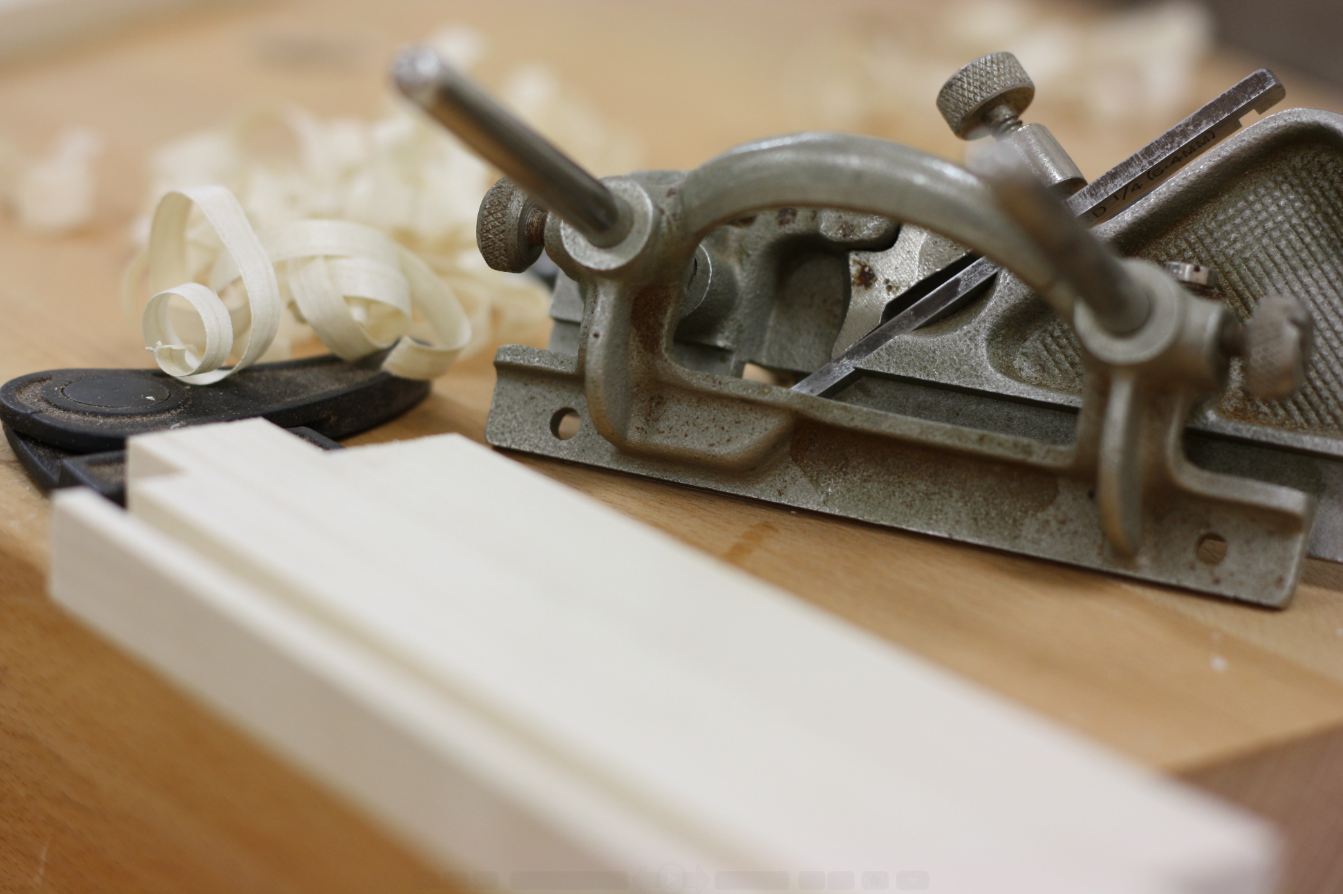
A fun little tool...
I was going to use a piece of hardboard for the bottom of the mahogany box, but… the prep and glue-up for the poplar board went so well I decided to do the same for the “good” box. And why on earth was I thinking of using hardboard, anyway?? Oh, because it’s stable and I can glue it in place to make the box stronger. Ah, well! Solid wood it is!
Dug through the pile of thin stuff and came up with a piece of Spanish Cedar (which is neither Spanish nor cedar) just a hair over 1/4″ thick. Not quite wide enough, though, so I did the same thing and glued it up. That will add a pleasant smell to the box! I might even advance that idea and add a Spanish Cedar lining…
While the bottoms were curing, I smoothed the sides (see first image) and prepped them for cutting a groove for the bottom board. The short ends are the easy bits – just run the ol’ Record 043 across the bottom of the inside face until it stops cutting. But the longer sides (the front and back of the box) are going to be a little harder, because I can’t run the plane all the way across its length – I’ll end up with grooves showing on the protruding pins. So they need to be stopped grooves. That’s easy to do when you’re using a router table. It isn’t quite so easy when you’re using an 043.
After a bit of thought, I came up with an idea I’m going to try. I marked where the grooves need to start and stop on the long boards. Then I chucked a 5/8″ (er… I wanted a little leeway) bit into my hand drill and bored out the starting and stopping points of the groove. The hope is that I can control the plane enough to keep it within those points. We’ll see how it goes!
If it doesn’t work, then I guess I’ll have to chuck a 1/4″ bit into my palm router and zip it out real quick (hey, it’s called a blended shop for a reason).
(And looking at that last picture, I’m reminded that I wanted to attach a longer wooden fence to that one… something else to add to the list!)
The Spiritual Side Of Woodworking…
Latest Issue
The latest issue of Popular Woodworking Magazine showed up in my mailbox the other day. It’s the only woodworking magazine I subscribe to anymore. I used to get two magazines – Popular Woodworking and Woodworking Magazine. I guess the one benefit of the merger (for me, anyway) is that I got to drop one of my yearly subscription fees.
I don’t buy this magazine for the power tool reviews and articles. In fact, I find myself glossing over them these days – they just do not maintain much of my interest. I enjoy the occasional hand tool review, though my obsession with purchasing MORE hand tools seems to have become somewhat subdued as of late (thanks, Anarchist’s Tool Chest!). A few of them have made their way into what I call my Big Picture Wish List, which is just a fancy way of saying, “Things I eventually want to have in my shop, only I’ll need a bit of time to save up for them”.
I do buy this magazine for the project and design articles. I especially enjoy the ones that just give out the basic dimensions or concepts and don’t provide me with an exact cut list. I don’t want to copy a project someone else has made; I want to take their ideas and add them to my own. A great example of this would be Gary Rogosky’s Jasmine Jewelry box from the June 2011 issue.
The timing couldn’t have been better as I was hashing out details for a box currently in-progress (still in progress, even; yeah… shop time isn’t coming so easily to me these days), that uses proud box joints, at the time of the article’s publication. I took his idea for cutting the box joints and modified a table saw jig to perform a similar function as his bandsaw idea. And it worked great! The joints slide together with just the slightest bit of friction, which should make for a nice tight joint once I add some glue.
(Some day I’ll work on cutting them by hand, but when I’m trying to do the best I can, I’ll use the tools available to me at the time.)
But what I really find to be the most enjoyable (and beneficial?) aspect of Popular Woodworking Magazine is what I like to call the “spiritual” articles. They often only partially contain woodworking references, but they are always relevant to how I approach (or want to approach) my woodworking. This spiritual content is clearly epitomized in an article in the latest issue, “A Teacup & 8 Dinner Plates,” by Toshio Odate.
His collection of short stories, presented in a way that reminded me of my college days, when I spent several semesters reading Lao Tzu’s Tao Te Ching and exploring Far Eastern culture, sets the pace of the article.
Find your favorite place to relax and make yourself comfortable. Read slowly and with comprehension. Enjoy Toshio’s words and pay attention to how he’s organized his thoughts. See the greater meaning in what he says. Feel his elation as he becomes the caretaker of Tenjin’s saw and sorrow as he preserves the memory of his master’s friend, a Geta-shokunin (wooden clog maker), by restoring his neglected saw. Visualize yourself as the unknown amateur woodworker who puts his heart and soul into making a hope chest for his daughter.
And then let that thought choke you up, as it did me.
After I finished reading the article, I sat in reflection for some time. Am I the best steward of my tools? What can I do to improve? How much of my soul do I pour into each project and how can I make them a better reflection of myself? A nearby notebook is suddenly filled with ideas and thoughts. In the workshop, it gets pinned to a wall so I’m constantly reminded of what I want to do and how I’m going to get there.
This spiritual approach to my hobby is what I love most about woodworking. This is what inspires me to do better and make more, not the latest table saw or cordless drill/driver.
Thank you, Toshio Odate. I am forever grateful for the stories you’ve shared.
Book Review: Made By Hand
Made By Hand: Furniture Projects From The Unplugged Shop
By Tom Fidgen
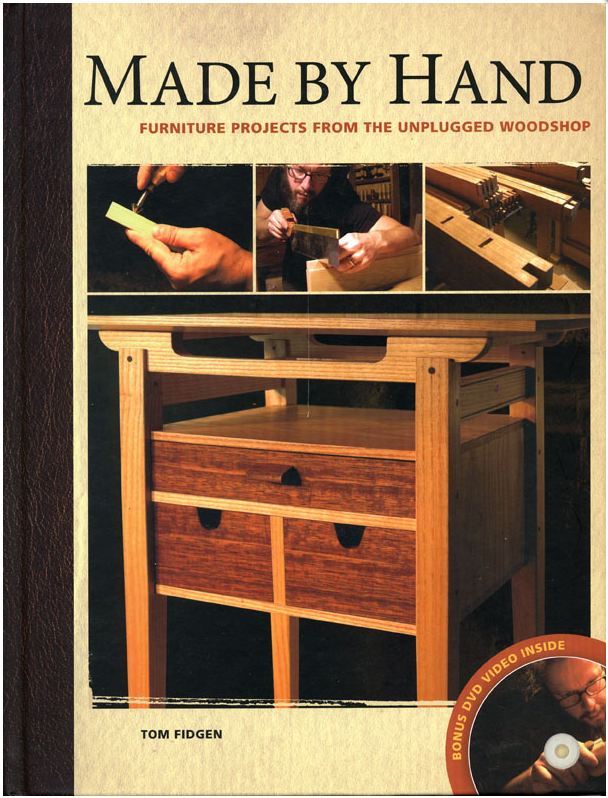
Made By Hand
I started reading Tom Fidgen’s blog, The Unplugged Woodshop, back in 2008. For more than a year, I followed him as he progressed through the various stages of his projects, impressed with his writing style, rejoicing in the occasional philosophical thought that made me look at the mundane from a different point of view, and fully delighted with his carefully thought out words and the incredible photography accompanying each entry. So, when he announced he was in the process of writing a book, called Made By Hand, I couldn’t wait to get my own hands on it. And then, a bit later, when he said he was taking pre-orders, I was one of the first to sign up. If it was anything like his blog writing, I knew it would be well worth the money. Finally, in November of 2009, my copy of Made By Hand arrived in the mail and I immediately dove in.
Right out of the box, I was impressed with what Tom had put together. I really prefer the 8.5”x11” format in a woodworking book, which is what Tom used, and I’ll pick a hard-bound book over a soft-bound copy of the same book any day of the week. The paper is high quality and low gloss, and the simple serif font is set on an off-white background, so the pages are easy to turn and easy on the eyes. Anyone who has enjoyed one of James Krenov’s books will find the familiarity of the front cover quite pleasing – certainly Tom is influenced by Mr. Krenov in more than just his project design.
My experience with real honest-to-God artists, time and time again, has shown that their artistic talents are not limited to just one medium. Tom once again proves that theory with his book. He is not just a great woodworker; on the credits page, you will see him listed as the photographer. And the photography is indeed of the highest quality – each picture is framed just right, with an artist’s eye, to properly portray the intended message without so much clutter. So far this book was living up to every one of my expectations.
Finally, I got to the content of the book. It is broken down into two basic parts. The first part is a section of three chapters that cover the essentials of what basic tools you should have in your shop, useful workbench appliances, and detailed information on some hand tool techniques. The second section contains design ideas and a walk-through for six projects.
More excited than ever, I began reading. I spent most of an afternoon plowing my way through the book; unfortunately, this is where the brass started to lose some of its shine. Thinking that maybe it was just me, I read it again, more slowly, over a period of about two weeks. The brass was still tarnished. (Please keep in mind, as you read this part of the review, that I write and edit technical documentation for a living, so what may be obvious and troublesome to me could very well pass by most people unnoticed.)
While, for the most part, the writing was fairly clear and the sequence well-organized, it was not the same writing I was used to seeing in his blog. Oddly enough, it seemed more casual than his blog writing ever was, with incomplete and poorly structured sentences throughout. Maybe it was a result of time constraints with the writing or, more likely, the editing. Or maybe Tom was trying to be creative in order to avoid the dull and humdrum content one finds in so many books on woodworking. Whatever the case, I felt it needed a bit more work. Overall, I was fairly pleased with the end result, but, personally, I would be happier with a second (edited) edition.
Book Review: Hand Tool Essentials
Hand Tool Essentials – Refine your power tool projects with hand tool techniques

Hand Tool Essentials
From the Editors of Popular Woodworking Magazine
If you are a power tool woodworker interested in taking your woodworking to a new level, then this collection of articles, pulled from the covers of Popular Woodworking Magazine, is a great place to start. Chris Schwarz sets the pace for the rest of the collection in the first of seven chapters, with three introductory articles discussing the reasons for, providing the motivations to, and outlining the fiscal ease in which you can incorporate hand tools into a power tool shop.
Since most hand tools do not work well when dull, the second chapter is comprised of nine articles dedicated to helping you make your tools sharp. These articles focus on sharpening plane irons, chisels, scrapers, and draw knives and also cover some of the different sharpening techniques, like using the ruler trick or adding a camber to your plane blades.
Chapter 3 covers hand planes and is the subject with the most articles dedicated to it. There, you will find information on what different kinds of planes there are and when to use each one, how to restore a flea market find and how to tune a new one, and on using wooden planes, smoothing planes, and jack planes. The last article is a bit of eye candy, with some great photos and information on infill planes.
The next two chapters discuss the use of hand saws and chisels. In the chapter on saws, Frank Klausz gives us the final word on dovetails and Chris Schwarz discusses East vs. West. Another article goes into detail on the usefulness of the bench hook and how to make one. The chapter on chisels covers basic and advanced chisel techniques, restoring an old chisel, and modifying stock chisels to work better.
Do you know how to properly use an awl? Or what the difference is between a striking knife and a marking knife? Or how to glue up a table base without using clamps (I’ll give you a hint – it involves drawboring)? These answers and more can be found in Chapter 6, which contains several articles on the other hand tools you might want in your shop.
The final chapter provides you with the perfect excuse for buying some hand tools – projects! Start off your bench obsession with the Roubo-style workbench. Then follow it up with a cabinet to store your planes, a sawbench for sawing boards using the proper form, and some miter shooting boards for making tight, precise joinery.
The articles are all well-written with crisp clean photos and clear captions. They are both concise and detailed and easily read one at a time or all in one sitting. Had I not won this book for planing the flattest board at a Chris Schwarz hand plane class earlier this year (err… 2009), I wouldn’t hesitate to spend the retail price of $24.99 to add it to my permanent collection.
Book Review: The Anarchist’s Tool Chest
I have too many tools. No, I’m serious! I have too many tools!

The Anarchist's Tool Chest
(I’ll wait until you’re done laughing before I continue…)
At some point, I went from buying tools at estate sales and garage sales, because I needed to outfit my shop, to “rescuing” that lone ¾” Stanley 750, even though I already have two of them at home. This became a sudden reality check when I tried to organize things to bring them into the new shop. I have (at least) four full sets of chisels and eight lignum vitae carving mallets, for Pete’s sake!
So when I heard about Chris Schwarz’s new book, The Anarchist’s Tool Chest, and read a little about the concepts behind it – bucking the current trend of wasteful consumerism in woodworking and outfitting your shop with only the essential woodworking tools – I knew it was a book I needed to get my hands on as soon as it was available.
My (autographed) copy arrived two days after the first shipment of orders. Like several other recent Lost Art Press publications, this book comes in a cloth-covered hard bound copy and it is made with quality paper and an excellent binding technique. I dove into it that first night and have been reading (and re-reading certain parts) in most of my free-time ever since. The print is easy on the eyes; the writing is clear, concise, and fun to read; the photos are plentiful and well-placed.
If you have unlimited shop space, plenty of disposable income, and a dislike of puns and groan-worthy woodworking humor, then this book is probably not for you. If, on the other hand, you want to develop a good set of quality tools to get you busy making things out of wood with a reasonable amount of expenses (notice I didn’t say minimal expenses – quit being cheap!), and enjoy fun and witty writing (not many woodworking books make me laugh out loud), then you should consider reading this book before you buy even one more tool.
The first section of the book, entitled “Memory”, discusses the reason and the concept behind the book in great detail, with the end goal of trying to get people to wake up and break the cycle of buying cheap crap. This is where you also get to see the all-important list of tools you should consider buying (or “you get to keep”, in my case, though I am a little light in the saw department still). Chris also discusses the work shop environment in general, and what kinds of things we might do to create a welcome environment where we can comfortably work on our projects.
The second section, “Reason”, is the meat of the book. It breaks down the tool list in great detail and examines why each tool is on the list, along with a bit of use and upkeep information. This section is riddled with useful tips (along with a large number of puns). The information provided does not by any means replace a week-long class on using hand tools, but it is a good starting point.
The final section, called “Experience”, is mostly involved with building your own anarchist’s tool chest. Chris discusses important dimensions, what kind of wood and joinery to use, what finish is best, and ideas on how you might organize the inside.
His appendices include a chart of what tools some historical tool lists included and a very dangerous section on sources for finding antique tools (read at your own risk). In a thought-provoking Afterword, Chris highlights the fact that our government and free-enterprise will not preserve our craft; this task is left up to you and me, the “passionate amateurs”.
I do not think I could give this book a higher recommendation.
My Green Woodworking…
There are several ways one can go about doing green woodworking.
You can reduce:
Every woodworker I know already reduces their waste. They call them “scrap bins”, but I doubt most woodworkers actually think of the wood in them as scraps. They save any piece of wood more than 6″ long (in some cases, like my expensive and difficult-to-obtain bog oak, I save pieces smaller than 6″ long) and often are able to find a use for it in a later project. To put it simply, use as much of your wood as you can; leave very little for the trash or burn pile.
You can reuse:
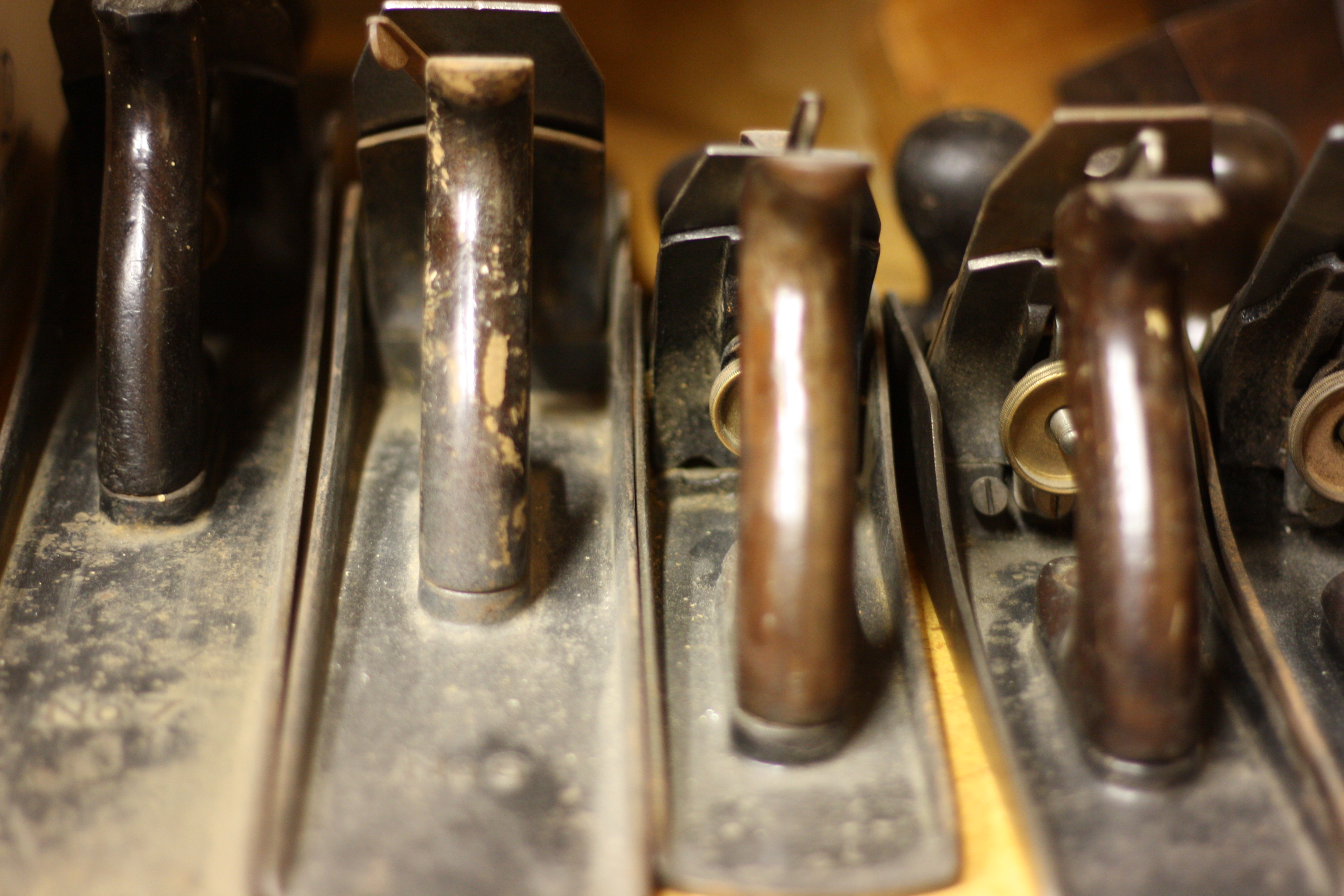
Some of them in as-found condition still...
Rehab antique tools instead of buying new ones! They are often of better quality construction than any tools made today that aren’t high-end (and expensive) and they are readily available in most locations. More than 75% of the tools in my workshop are antiques (rehabbed or still in as-found condition). Even some of my big boy power tools are more than 50 years old (a Rockwell drill press and a Rockwell scroll saw, both from the 1950’s, and an 8″ Wallace jointer from the 1930’s).
My big focus, when it comes to reusing, is the wood itself. The main wood I use in most of my boxes is reclaimed white oak. If you look at my gallery page, you’ll see that in most of the boxes posted (all, at the time of this writing, actually). This is some wood I have in abundance, and I enjoy using it! It all comes from an old house that was on a farm owned by my family. My brother built a house on that farm and, when his children got old enough, the old structure became a safety hazard, so we had to tear it down. Let me tell you – if we hadn’t used hammers and saws and (eventually) a tractor to take it down, that sucker would still be up for another 150 years. It was framed with green white oak, every nail clenched, and then the outside of the frame was sheathed with green white oak lumber, mostly 10′ long and averaging 8″-10″ wide. Each board was clench-nailed to the frame three times across the width in no less than three different locations. Then the outside of the house was further covered with cypress clapboard siding and slathered with several coats of leaded paint.
The end result is that after more than 40 hours of hard work, I had upwards of 50 or 60 boards of straight air-dried 1x white oak (after carefully unclenching several thousand nails – lordy, but that did a number on my wrists!) and a good 20 or 30 boards of true 2x dimensions and even a few larger 4x and 6x boards. This isn’t “weathered” barn wood, which really isn’t that desirable, because of a high silica content from years of exposure to elements and sand and grit and dirt; that stuff is brutal on planer and plane blades. Instead, this wood looks just like any other stack of air-dried wood that is 10 years old – until you plane off that top layer and you see the tight old-growth rings that set this wood apart from most contemporary white oak lumber you might buy today.
I also use bog oak, which is one of the ultimate woods, when it comes to “reusing”! Much of the bog oak I have didn’t actually come from a true bog of Ireland, but from the city of London in England. During their occupation of the city, Romans built docks to access the Thames river; they supported these structures by driving oak log pilings into the mud. This lack of moisture oxygen and exposure to water saturation acted, in essence, like a bog, as far as the wood was concerned. 2000 years later, these logs surface during construction projects and some thrifty soul collects them and turns them into lumber. The waste from the drying process is about 70% (if you think that is a lot, try drying wood that has 100% moisture content for 2000 years and see how well you can do), which makes this stuff the opposite of cheap. Add the shipping costs from the UK and I don’t even want to know what the board foot cost would calculate out to be if it did come in plank form (it is mostly in smaller blocks not larger than 8″ in length and 5″ in width). But I use it as accent pieces, so a little wood goes a long way. And considering I don’t pay for most of the primary wood I use, I don’t mind the higher price for this premium reclaimed wood.
In my shop, awaiting use, I also have some ancient Kauri wood and some old growth mahogany. I’m blessed to live just an hour away from the Greener Lumber mill, in Mexico, MO, and when I finally get into a more productive mode, I plan on taking advantage of that for some of my premium boxes.
A lot of the other wood I get is generally re-purposed or considered “scrap” by one of the major lumber suppliers here in St. Louis (anything less than 3′ long). I can also sometimes get African Mahogany and walnut from my little brother, who works in a cabinet shop that does custom doors, windows, mouldings, and cabinets. The shop tosses anything under 36″ into their dumpster and the employees pull it right back out at the end of the day and bring it home. If I put in a “request” with him, and sweet talk him enough, he’ll usually come through with five or ten boards of it every few months, which is enough for several boxes.
You can recycle:
I have a fireplace. Any dimensioned lumber that is too short to be used in a box gets split into smaller pieces with my old Eastwing hatchet and used as kindling. If I have a pile of just domestic wood shavings, I’ll put it in my yard waste container, which gets turned into mulch at the local recycling center.
My Green Shop…
In building my new shop, I tried to to be as earth- and human-friendly as I could, without spending an obscene amount of money or taking it to an obnoxious extreme. As we remodeled other parts of our house, I held on to some things I knew I might be able to reuse in the workshop. The three can lights along the back wall were pulled from our hearth room (we replaced those lights with insulated units to reduce air flow between that room and the attic space above it). Some of the wall outlets came from other rooms that were renovated within the last four years. Once I get it installed, the trim will be painted with trim paint left over from another renovation project.
After we replaced the can lights in the hearth room, we wanted to add extra insulation to our attic spaces. Working in the hazardous waste field, my wife is all too familiar with VOCs and how much formaldehyde an additional 13″ of fiberglass insulation might put into our house. So we spent some effort to locate a company in the area who would use formaldehyde-free fiberglass insulation. It ended up costing us a third less than comparison bids we received for regular insulation!
When it came time to insulate my workshop walls, I didn’t want to just go out and buy pink fiberglass insulation after we’d spent so much time trying to get the rest of the house insulated properly. Unfortunately, the company we’d previously used only had formaldehyde-free insulation in the loose, blown-in form, not in paper-backed batting. But after lots of Google searching and quite a few phone calls, I finally located the same brand of insulation, in craftpaper-backed batting, in my home town! It, too, was cheaper than what the same amount of pink insulation would have cost. And I found out, with a bit of work, I could fit seven such bundles inside my Xterra (man, was that a quiet ride home!).
With the walls insulated, drywalled, taped, and mudded, I wanted to get a few coats of paint on them. If you go to your big box store or a painting specialty store, you can buy special low-VOC paint. But it costs a lot more per gallon than regular paint. Fortunately, I didn’t need to spend the extra money! As it turns out, most of the VOCs are found in the colored pigments added to the base paint. By painting the walls a slight off-white color, I used paint that was already low in VOCs without spending the extra money.
Last, but not least, in my workshop renovation was the floor. I’ve had concrete floors in my workshops for years now, and it’s never been comfortable. It certainly wasn’t easy on any tools that might have been dropped or rolled off the workbench. So I started looking into what might be easy on the feet and back, kind to my errant tools, inexpensive, and eco-friendly, to boot!
I called a life-long friend of mine, who also happens to own a flooring store, and he set me up with a fairly new cork floor product! It is a click-install floating floor that comes in 4″ wide planks, like an engineered or laminate floor. It is comfortable to stand on, easy on my tools, and properly harvested from a renewable resource! The normal price was very competitive with engineered floors; I got it for a somewhat better price because he’s my older brother’s best friend.

 thekiltedwoodworker